
Burnout Isn’t About Work - It’s About Emotional Load
Burnout Isn’t About Workload: It’s About Emotional Load
When your tasks themselves are manageable but constantly managing everyone’s feelings about them is what leaves you drained, exhaustion looks very different.

It’s 10:47 PM on a Tuesday, and Sarah’s still awake. The project is done, but her mind keeps looping through tomorrow’s email to her manager. She’s rewritten it four times, testing different tones: friendly but not too casual, direct but not demanding, confident but not pushy. The request itself takes one sentence. The anxiety about how it will be received has consumed an hour, and she’s done this same mental rehearsal three times this week alone.
This isn’t on her to-do list. It won’t appear in any productivity report. But it’s exhausting her more than any deadline ever has.
If this sounds familiar, your exhaustion comes less from the number of tasks and more from the emotional weight you are carrying, and recognising this distinction changes everything.
What Is Emotional Load Burnout?
Emotional load burnout refers to the exhaustion that comes not from how many tasks are on your list but from the invisible mental and emotional effort that goes into them. This can include:
Managing relationships
Monitoring reactions
Suppressing authentic responses
Carrying the psychological weight of workplace dynamics
Unlike traditional burnout models that focus on workload intensity, emotional load burnout centres on the depletion caused by emotional labour, the regulation of feelings and expressions to meet professional or social expectations.
The Science Behind the Exhaustion
Research shows emotional labour contributes to burnout through a mechanism called emotional dissonance, the gap between the emotions you actually feel and the emotions you’re required to display.
When you’re constantly:
Surface acting – faking emotions you don’t feel
Deep acting – genuinely trying to feel what’s expected
…you deplete cognitive and emotional resources in ways task-based work doesn’t.
Your prefrontal cortex, responsible for focus, planning, and decision-making, is running multiple high-demand applications simultaneously. Eventually, everything slows down.
Key finding: Emotional dissonance often predicts burnout more than workload, hours worked, or job control.
How Emotional Load Differs from Related Concepts
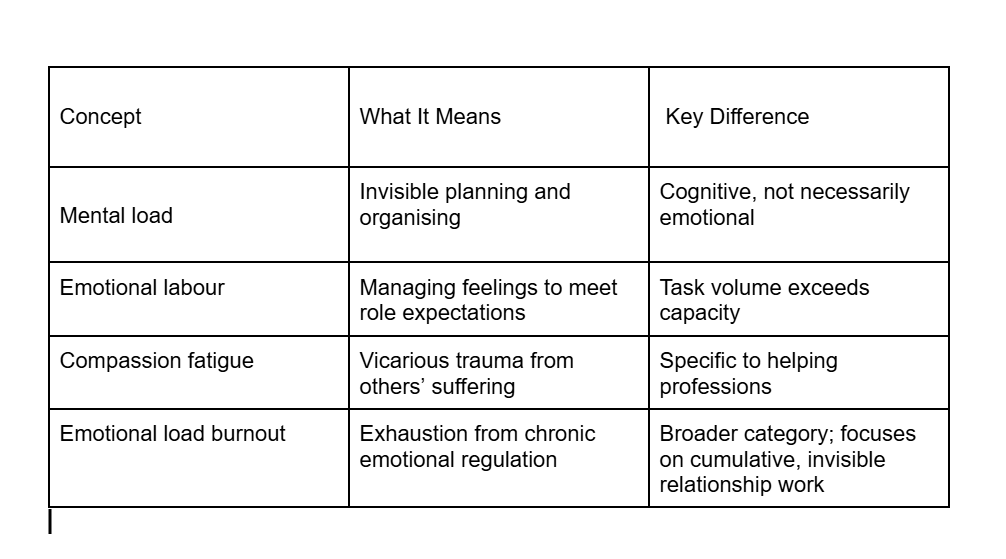
Why Millennials and Gen Z Feel It Hardest
Digital-first workplace cultures amplify emotional load for younger professionals through:
Digital connectivity – Constant tone-monitoring across Slack, email, and Zoom
Performative professionalism – Continuous projection of enthusiasm and availability
Economic precarity – Workplace relationships feel high-stakes
Now, you’re managing emotions in person and across every digital channel, often outside traditional working hours.
The Three-Type Emotional Load Framework™
Recognising the types of emotional load you carry helps you address them strategically.
1. Relational Maintenance Load
Keeping workplace relationships smooth:
Anticipating reactions
Absorbing frustrations
Smoothing over conflicts
Adjusting communication for different people
Example: A project coordinator predicts how marketing will react to a developer timeline and pre-emptively manages both sides’ expectations.
2. Performance Load
Managing how you’re perceived:
Monitoring tone in writing and speech
Rehearsing conversations repeatedly
Over-explaining simple requests
Suppressing emotions that aren’t “professional”
Performing enthusiasm or empathy you don’t feel
Example: A manager spends 25 minutes crafting a three-sentence feedback email, testing different ways it might come across.
3. Responsibility Load
Feeling accountable for others’ emotional states:
Carrying guilt for setting boundaries
Being the go-to emotional support
Managing upward to protect your manager’s feelings
Example: A helping professional worries about a client’s wellbeing long after work because they feel personally responsible.
Critical insight: Often, all three types operate simultaneously: relational, performance, and responsibility load, invisibly draining you.
Why Emotional Load Depletes You Differently
Task-based work offers completion, you finish a report, submit a project. Emotional load rarely provides that satisfaction.
Three mechanisms of exhaustion:
Invisible and unvalued work – No recognition, rest periods, or compensation
Constant low-level activation – Your nervous system is always “on,” simulating potential interactions
Identity fragmentation – Performing emotions you don’t feel creates a disconnect from your authentic self
Eight Signs Emotional Load Is Draining You
Obvious signs:
Rehearsing conversations repeatedly
Feeling responsible for others’ emotions
Feedback leaves you drained
Constantly “reading the room”
Over-explaining requests
Saying no feels impossible
Subtle indicators:
Rest doesn’t restore you
You dread interactions more than tasks
One of my Clients insight was that they realised it wasn’t the tasks wearing them out; it was constantly managing everyone else’s comfort with their existence in the role.”
Practical Steps to Reduce Emotional Load
Step 1: Name the Pattern
Observe your emotional load without judgment. Ask:
Which interactions drain me most?
When do I rehearse conversations unnecessarily?
Where do I feel responsible for others’ emotions?
Step 2: Replace Mind-Reading with Questions
Shift responsibility:
Instead of assuming: “Is my manager upset?”
Ask: “Is there anything about this project I should know?”
Step 3: Use Boundary Scripts Without Over-Explaining
Examples:
“I don’t have capacity for that this week.”
“I can do X by Friday or Y by Monday; which matters more?”
Step 4: Practice Micro-Assertiveness
Start small and build tolerance for temporary discomfort:
Order exactly as you want without apologising
Disagree mildly in low-stakes conversations
Say no to small requests without over-justifying
Step 5: Build Recovery That Restores Emotional Resources
Physical rest isn’t enough. Focus on:
Solitude without productivity pressure
Activities where you’re not performing
Connection without managing others’ emotions
Embodied stress-release (movement, singing, laughter)
Boundaries around emotional availability
Even 10 minutes of deliberate, restorative practices can begin replenishing emotional resources.
Moving Forward
Awareness is power. Sustainable work requires:
Noticing when you’re over-functioning emotionally
Accepting that some discomfort belongs to others
Building reciprocal relationships
Advocating for organisational support
Remember, this is ongoing, imperfect, human practice, not a one-time fix.
When to Seek Professional Support
Consider therapy or coaching if:
People-pleasing or conflict avoidance is rooted in trauma
Boundaries feel impossible to implement
Anxiety about others’ reactions interferes with daily life
Workplace is toxic or punitive
Burnout has progressed into mental or physical health issues
Professional support can guide recovery, set boundaries safely, and address deeper patterns.
Building Workplaces That Reduce Emotional Load
Managers and leaders can reduce team load by:
Clear priorities and decision-making authority
Psychological safety
Acknowledgment that relationship management is real work
Modelling boundaries
Direct communication culture
Practical strategies:
Monthly Emotional Load Audits – Ask, “What invisible work am I missing?”
No-Response-Needed Email Culture – Reduce monitoring load
Priority Matrix Protocol – Explicit prioritisation frameworks
Avoid rewarding endless availability or punishing reasonable boundaries.
Final Thought
You’re not burnt out from your workload — you’re drained from emotional load.
Start with one small step:
Notice a pattern this week
Ask a clarifying question
Set one boundary without over-explaining
Practice micro-assertiveness
Your exhaustion is legitimate. The invisible work you do depletes real resources. Recognising it is the first step toward sustainable work and authentic connection.
You deserve to work in ways that don’t deplete you. Start today.

