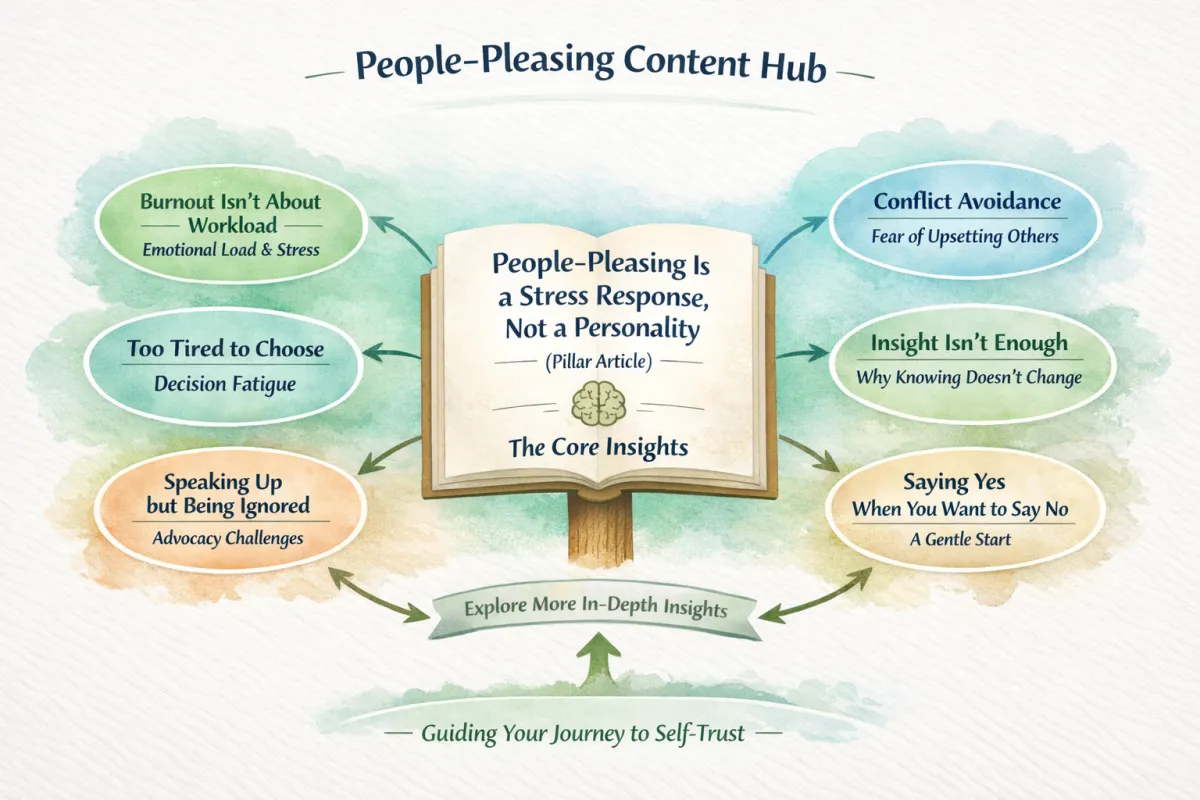
People - Pleasing is a stress response
People-Pleasing Is a Stress Response, Not a Personality
Why your automatic “yes” isn’t weakness, it’s your nervous system trying to keep you safe

Do you often say yes when you want to say no?
This isn’t because you lack confidence, boundaries, or strength.
And it’s not because you’re “too nice.”
For many people, people-pleasing is not a personality trait at all.
It’s a stress response, an automatic survival strategy shaped by the nervous system.
One that once helped you stay safe in relationships.
And one that, over time, may now be costing you energy, clarity, and a sense of self.
The people most affected don’t look like they’re struggling
People-pleasing tends to show up most strongly in people who are:
caring and conscientious
emotionally aware
responsible and capable
relied on by others
good at reading the room
You may be good at your job. You may even love what you do. Others might describe you as calm, steady, or dependable.
And yet, beneath the surface, you may feel:
exhausted even when life looks “manageable”
unsure what you actually want
emotionally flat or disconnected
resentful, then guilty for feeling that way
This isn’t a character flaw.
It’s what happens when your nervous system has learned that maintaining harmony equals safety.
Why your body says “yes” before you decide
Many people describe people-pleasing like this:
“I hear myself agreeing, and only afterwards realise I didn’t want to.”
That’s because people-pleasing doesn’t start in your thinking brain.
It starts in your autonomic nervous system, the part of you that scans constantly for safety and threat, saying “Am I okay here?” long before conscious thought kicks in.
If, at any point in your life, your system learned that:
disagreement led to tension
expressing needs caused conflict
saying no resulted in withdrawal or upset
Then your body adapted.
It learned that compliance kept connection, and connection meant safety.
Over time, that adaptation became automatic.
People-pleasing as a stress response (not a flaw)
From a nervous-system perspective, people-pleasing aligns with what’s often called the fawn response, a survival response alongside fight, flight, and freeze.
When your brain perceives relational threat (even subtly), your system may shift into appeasement mode:
suppressing your needs
accommodating others
staying agreeable
avoiding conflict
This happens beneath conscious awareness.
You’re not choosing it.
Your body is trying to protect you.
A simple way to understand the nervous system
Polyvagal theory helps explain this.
Very simply, your nervous system moves between different states:
Ventral vagal (safe and connected):
You feel calm, grounded, able to express yourself and set boundaries.Sympathetic (mobilised):
Fight or flight — anxiety, urgency, reactivity.Dorsal vagal (shutdown):
Freeze, collapse, numbness, dissociation.
In people-pleasing, the social engagement system is recruited for defence.
You appear calm and friendly on the outside while internally scanning, adjusting, and self-silencing.
This is why people-pleasing is so draining, it looks regulated, but it’s not restful.
“But nothing bad happened to me…”
Many people dismiss their patterns because they don’t identify with trauma.
But people-pleasing doesn’t require obvious trauma.
It often develops in environments where:
emotions were unpredictable
being “good” mattered
others’ needs came first
harmony was prioritised over honesty
A developing nervous system learns patterns based on repetition, not logic.
If asserting yourself led to discomfort or disconnection, your body learned to avoid it, automatically.
That learning can persist long after the environment has changed.
How people-pleasing leads to burnout
The cost of people-pleasing isn’t immediate. It accumulates.
Over time, you may notice:
emotional exhaustion despite coping well
overthinking conversations
difficulty making decisions
resentment that feels out of character
loss of joy or motivation
You spend your energy outward, managing, anticipating, accommodating, and there’s little left when you stop.
This is emotional load, and it’s a major contributor to burnout.
Not because you’re doing too much, but because you’re carrying too much internally.
Decision fatigue: when your brain has nothing left
Emotionally demanding roles require you to:
decide
prioritise
manage risk
regulate emotions
Each decision uses mental energy.
By the end of the day, your brain may feel foggy or resistant to even small choices.
This is decision fatigue, not laziness or lack of motivation, but cognitive depletion.
When your system has spent all day staying safe, it doesn’t want to make another move.
How to recognise people-pleasing as a stress response
People-pleasing driven by stress often includes:
saying yes automatically, then regretting it
struggling to know what you want
excessive apologising
feeling responsible for others’ emotions
anxiety at the thought of disappointing someone
physical sensations when considering boundaries (tight chest, knot in stomach)
These are nervous-system signals, not personality traits.
Why insight alone doesn’t change the pattern
Many people understand why they people-please, and yet still do it.
That’s because insight lives in the thinking brain, while people-pleasing lives in the body.
Change doesn’t come from forcing yourself to be different.
It comes from helping your nervous system feel safe enough to choose.
This is why willpower-based approaches often fail, and why compassion matters.
What actually helps (gently)
You don’t need to become confrontational or “harder”.
Supportive shifts include:
pausing before responding (“Let me think about that”)
noticing body sensations before answering
practising low-stakes boundaries with safe people
learning nervous system regulation
allowing discomfort without self-abandonment
These small changes send powerful signals of safety to your system.
From survival to self-trust
The goal isn’t to stop caring.
It’s to care without disappearing.
As people-pleasing softens, many people notice:
clearer preferences
more energy
less resentment
deeper, more honest relationships
This isn’t about changing who you are.
It’s about returning to who you were before your system learned it had to work so hard to belong.
A gentle reflection
You might ask yourself:
Where do I say yes out of fear rather than choice?
What does my body do when I consider saying no?
What did this pattern once protect me from?
There’s no rush to fix anything.
Awareness is already movement.
Closing
People-pleasing is often the sign of a nervous system that learned to survive through connection.
And what was learned can be gently unlearned.
If this resonated, you’re welcome to explore the Struggle to Strength blog further, where reminder by reminder, we look at emotional load, burnout, and rebuilding capacity, at a pace that respects your nervous system.
You don’t have to push your way out of this.
You can soften your way forward 🌱

